Research · Single-study breakdown
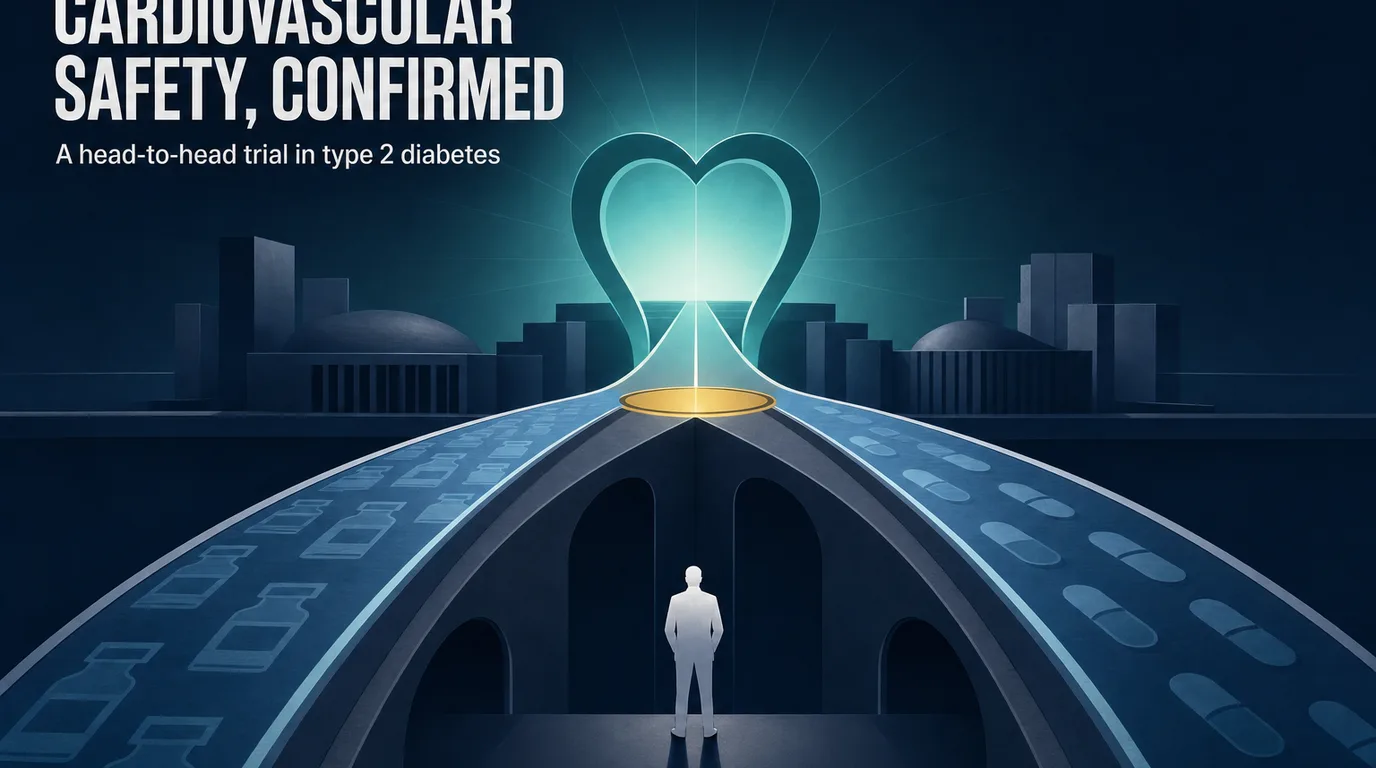
Foundayo's ACHIEVE-4 heart-safety trial: as safe as insulin for the heart, with an early signal of fewer deaths
What this means for you
If you have type 2 diabetes and heart or kidney disease, this trial is reassuring about one specific question: in this study, the pill did not put the heart at more risk than insulin did. It also caused far fewer episodes of low blood sugar, which is one of the main day-to-day worries with insulin.
The finding getting the most attention, fewer deaths, needs care. It was not the question the trial was built to answer, so it is a signal that still needs confirming in a study designed to test it.
In the US, Foundayo is FDA-approved only for weight management, not for type 2 diabetes. Lilly has said it planned to seek a type 2 diabetes approval; until the FDA decides, using it for diabetes is not an approved use there.
This is not advice to start, stop, or switch any medication. If you take insulin and are curious whether an alternative could suit you, that is a conversation for you and your doctor, based on your own health history.
How the trial was run
ACHIEVE-4 was a phase 3, open-label, randomized trial at 317 sites in 16 countries and territories, published in The Lancet and registered as NCT05803421. It enrolled 2,749 adults with type 2 diabetes, overweight or obesity (BMI 25 or higher), and an A1C between 7.0% and 10.5%, who were taking up to three other diabetes medicines (metformin, a sulfonylurea, and/or an SGLT2 inhibitor). Every participant already had established heart disease or chronic kidney disease: 85.9% had heart disease and 37.6% had kidney disease. On average they were 63 years old, with an A1C of 8.2%.
Half took orforglipron once a day by mouth, raised step by step to the highest dose they tolerated. In the trial this was a capsule (up to 36 mg) equivalent to the Foundayo tablet (17.2 mg). The other half took insulin glargine, a long-acting injected insulin, with the dose adjusted over time. Because one treatment is a pill and the other an injection, participants and doctors knew who was getting what.
The main question was about safety, not benefit: did the pill cause more heart problems than insulin? The trial measured “major adverse cardiovascular events”: heart-related death, heart attack, stroke, or a hospital stay for unstable chest pain. This is a “non-inferiority” design. It is built to show a new drug is not worse, not to prove it is better. The trial ran until enough of these events had happened, which took a median of about two years per person.
What the data showed
Heart safety (the main question). Major heart events happened in 4.2% of people on the pill and 5.0% on insulin, a hazard ratio of 0.84 (95% CI, 0.59 to 1.20). The trial’s pre-set bar for “not worse” was an upper limit below 1.8, and the result cleared it. Because the range includes 1.0, the trial does not show the pill is better for the heart. It shows it is not worse.
Deaths. 19 of 1,371 people on the pill died (1.4%), compared with 43 of 1,355 on insulin (3.2%), a hazard ratio of 0.43. This was a pre-planned extra analysis, and its p-value of 0.002 is “nominal”: the trial was not set up to correct for testing many outcomes at once, so this result cannot be treated as proven. The Lancet authors conclude that the pill’s heart safety was confirmed; they do not claim a reduction in deaths. The trial report does not explain why deaths differed.
Low blood sugar. Clinically significant or severe low blood sugar (below 54 mg/dL) happened in 6.8% of people on the pill and 19.2% on insulin.
Blood sugar and weight at 52 weeks. A1C fell by 1.6 percentage points on the pill and 1.0 on insulin. Weight fell 8.8% on the pill and rose 1.7% on insulin.
These extra measures were exploratory, so treat them as supporting signals rather than proof:
- At 104 weeks, 54.6% of people on the pill had an A1C of 6.5% or lower, compared with 23.8% on insulin.
- Kidney function, measured by eGFR, declined somewhat more slowly on the pill than on insulin.
- On the pill, blood pressure, triglycerides, and a marker of inflammation (hsCRP) fell from where they started.
Side effects. Digestive side effects were reported by 62.1% of people on the pill and 14.2% on insulin, such as nausea, vomiting, diarrhea, constipation, and decreased appetite. They were the most common reason people stopped the pill. During the first 52 weeks, 10.6% of people on the pill stopped it because of side effects.
What this study can't tell us
- A safety test, not a “better drug” test — the trial was designed to show the pill is not worse than insulin for heart events, and it was not built to show it is better.
- The death finding needs confirming — it was an extra analysis that was not adjusted for testing many outcomes, so it is a signal, not proof.
- Open-label — participants and doctors knew which treatment each person got.
- Compared against insulin only — not against GLP-1 drugs already used for heart protection, like semaglutide.
- A specific group — everyone had type 2 diabetes plus heart or kidney disease and a BMI of 25 or higher; results may differ for others.
- Industry-funded — Eli Lilly funded the trial, and several authors are Lilly employees.
Most diabetes drug trials of this kind are built to show a new drug does not raise heart risk, and this one cleared that bar. The parts worth watching are the far lower rate of low blood sugar compared with insulin, which matters day to day, and the gap in deaths, which is striking but unconfirmed. A pill that holds up on heart safety, without the low-blood-sugar risk of insulin, is a meaningful result. Whether it also saves lives is a question this trial raises but cannot answer.
Sources
- Cardiovascular safety of orforglipron versus insulin glargine in adults with type 2 diabetes at increased cardiovascular risk (ACHIEVE-4): a phase 3, event-driven, randomised, open-label, non-inferiority, active comparator trial — The Lancet (2026) · doi:10.1016/S0140-6736(26)01865-9
- Lilly's oral GLP-1 Foundayo (orforglipron) demonstrated cardiovascular safety alongside sustained A1C reduction and weight loss in its largest and longest type 2 diabetes study — PR Newswire (Eli Lilly) (2026)
- ACHIEVE-4 trial registration (NCT05803421) — ClinicalTrials.gov
Not medical advice. Educational summary of published research. Last reviewed Oct 27, 2026.