Research · Single-study breakdown
A glucose monitor helped people with type 2 diabetes who don't use insulin: what the CONNECT trial showed
What this means for you
If you have type 2 diabetes, don’t use insulin, and your A1c is above target, this is the strongest evidence so far that seeing your glucose in real time can help. In the trial, most people wore the sensor almost all the time, used their fingerstick meter far less, and spent about five more hours a day in the healthy range than people on usual care.
The device used in the trial, the Dexcom G7, is available today, by prescription. Whether insurance covers it for someone who doesn’t use insulin varies by plan. There is also at least one over-the-counter CGM cleared by the FDA for adults not on insulin, but it’s a different device, and this trial didn’t test it.
This is a good reason to ask your doctor whether a CGM makes sense for you and how you’d use what it shows. It is not a reason to change your medications or stop checking your blood sugar the way your care team has asked. A CGM is a tool for seeing what is happening; the benefit in this trial came from people and their clinicians acting on what they saw.
If you want to know what wearing one is like day to day, see our guide on using a CGM.
Why this trial matters
Continuous glucose monitoring is well established for people with type 1 diabetes and for people with type 2 diabetes who use insulin. For the much larger group with type 2 diabetes who don’t use insulin — the authors estimate about 20 million adults in the United States — the evidence has been thin. The American Diabetes Association’s 2026 Standards of Care rate the evidence for CGM in insulin users at the highest level (level A), but only at level C for people not on insulin. CONNECT was designed to fill that gap, and to do it where most of these patients actually get care: primary care practices, not specialty diabetes clinics.
How the trial was run
CONNECT, published in the New England Journal of Medicine on October 14, 2026 (trial registration NCT06601166), was a randomized controlled trial at 22 primary care practices in the United States. Between September 2024 and November 2025, it enrolled 283 adults with type 2 diabetes who had not used insulin in the past year and whose A1c was at least 7.5% at screening. Participants were 21 to 84 years old and had lived with diabetes for 1 to 37 years. About a third (32%) identified as non-White or as Hispanic or Latino.
Many were already on modern diabetes medicines: 40% were taking a GLP-1 drug (including dual GLP-1/GIP drugs), 37% an SGLT2 inhibitor, and 18% both. Everyone kept their existing medications.
Participants were randomly assigned to one of two groups:
- CGM group (145 people): wore a real-time Dexcom G7 sensor every day and were trained to use it.
- Usual-care group (138 people): used a standard fingerstick blood glucose meter as often as their doctor advised.
Both groups got the same diet and exercise education and the same visit schedule: telehealth visits at 1, 4, 8, and 19 weeks and clinic visits at 13 and 26 weeks. At each visit a clinician reviewed the glucose data available and recommended lifestyle or medication changes as needed. To measure results fairly, the usual-care group also wore a blinded CGM, one whose readings they could not see, for 10 days before each checkpoint.
The main measure was A1c at 26 weeks, measured at a central laboratory.
What the data showed
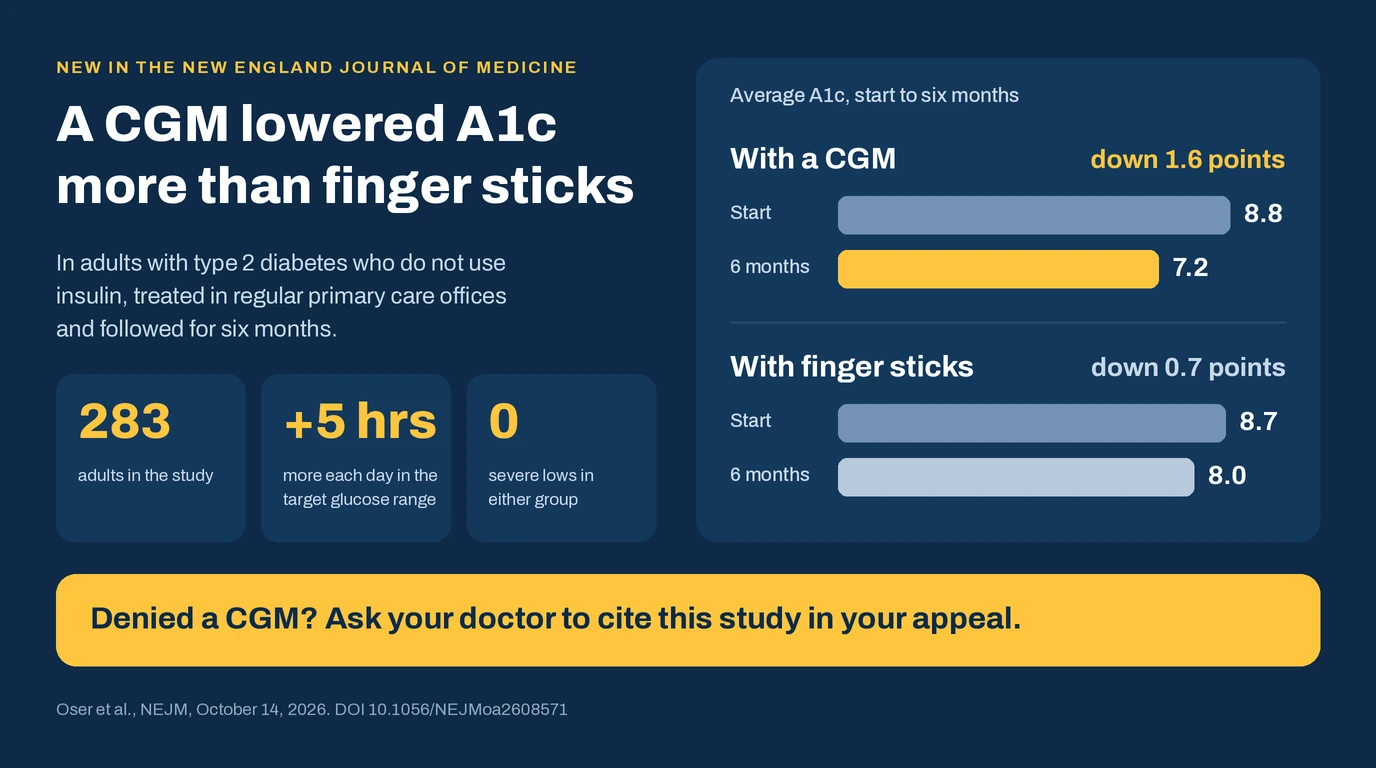
A1c. In the CGM group, average A1c fell from 8.8% to 7.2%, a drop of 1.6 points. In the usual-care group, it fell from 8.7% to 8.0%, a drop of 0.7 points. After adjustment, A1c was 0.9 points lower with a CGM (95% CI, −1.1 to −0.6; P < 0.001). In a secondary, exploratory analysis, 46% of the CGM group reached an A1c below 7%, compared with 24% of the usual-care group.
Time in range. The share of the day spent between 70 and 180 mg/dL rose from 29% to 62% in the CGM group and from 31% to 42% in the usual-care group. That 21-point difference works out to about five more hours a day in range. Time spent above 250 mg/dL, very high blood sugar, dropped to 7% of the day with a CGM versus 22% with usual care, and average glucose was 175 mg/dL versus 207 mg/dL.
Low blood sugar. Lows were rare in both groups before the trial and stayed rare. Time below 54 mg/dL was 0.02% of the day with a CGM and 0.19% with usual care. No one in either group had a severe low.
How much people used it. Use was very high: the sensor was worn a median 97% of the time, and 86% of people wore it at least 80% of the time. Fingerstick checks in the CGM group fell from a median of 3 a week to 0. Nearly everyone finished the trial: 97% in the CGM group and 90% with usual care.
Medication changes. Clinicians added a diabetes medication, most often a GLP-1 drug, for 31% of the CGM group and 17% of the usual-care group. Insulin was started in 4% and 2%. Because most participants had no new medication, the authors conclude that medication changes alone don’t explain the CGM group’s improvement, and that changes in daily habits likely played a part. The trial didn’t measure eating, activity, or adherence directly, so it can’t say which habits changed.
Weight. Both groups lost a little weight, 2.5 kg with a CGM and 1.8 kg with usual care, with no clear difference between them.
Who benefited. In exploratory subgroup comparisons, the advantage of a CGM looked broadly similar across age, sex, race and ethnicity, body weight, years with diabetes, income, education, insurance, and current diabetes medicines, including GLP-1 drugs. The gap appeared larger for people who started with a higher A1c and smaller for those who started below 8%. These subgroup analyses weren’t designed to prove differences, so read them as patterns, not conclusions.
Safety. Serious adverse events occurred in 6 people in each group, and all were judged unrelated to the trial. Three minor events in the CGM group, bleeding where the sensor was inserted or removed, were judged to be related to the sensor.
What this study can't tell us
- Six months is short. Whether the benefit lasts is not yet known. A 26-week extension is under way to see whether people keep wearing the sensor and whether the improvement holds.
- Trial conditions aren’t real life. Sensors were free and visits were frequent, both of which may have boosted how much people used the CGM. The authors note that use and benefit may be lower in everyday practice.
- Usual care wasn’t quite usual. The comparison group got far more follow-up than most primary care patients do, and improved by 0.7 points as a result. That makes the comparison fair, but it means neither group is a typical patient.
- It can’t say why it worked. Without data on eating, exercise, or medication-taking, the trial can’t separate the effect of the device from the habits it prompted.
- Participants knew their group. Wearing a visible sensor can’t be hidden, so expectations may have played some role.
- Too small for rare problems. The trial wasn’t large enough to detect uncommon safety events.
- Industry-funded. Dexcom, which makes the CGM used, funded the trial, supplied the devices, helped design it, and employs several of the authors. The paper states the company had no role in data collection or analysis and could not approve the manuscript.
- One device, one country. Results are for a real-time CGM in US primary care. Earlier, smaller trials of scan-to-view CGMs in people not on insulin found smaller A1c improvements, about 0.3 points.
The analyst take: the size of the effect is what stands out. A 0.9-point A1c advantage on top of whatever medicines people were already taking is the kind of difference usually associated with adding a drug, and here it came from information plus clinicians acting on it. It held up in a well-run randomized trial, in primary care, across a broad mix of patients, with nearly perfect device use and no added risk of lows.
The open questions are practical ones: whether people keep wearing the sensor once the study ends, whether the benefit lasts beyond six months, and whether it holds up when the sensor isn’t free and the visits aren’t frequent. Coverage for people who don’t use insulin is the obvious next issue. Trial evidence like this is what guideline writers and insurers look for, and CONNECT moves the evidence for this group well beyond where it stood. For the earlier conference report on CONNECT and the other studies presented alongside it, see our ADA 2026 roundup.
Frequently asked questions
1.Does a CGM help if I have type 2 diabetes and don't take insulin?
In the CONNECT trial, it did for most people. Over 26 weeks, adults not on insulin who wore a continuous glucose monitor lowered their A1c by about 0.9 points more than people who used a regular fingerstick meter, and spent about 5 more hours a day in the target glucose range. It is one trial, sponsored by the device maker, so it's a good reason to ask your doctor whether a CGM fits your situation — not a reason to change anything on your own.
2.Do I need a new medication to get these results?
No new drug was part of the trial. Everyone kept their existing diabetes medicines. Doctors did add medication for some people along the way — more often in the CGM group (31%) than in the usual-care group (17%) — but most participants got no new prescriptions, which is why the researchers think changes in daily habits explain much of the benefit.
3.Can I get a CGM without insulin?
The trial used the Dexcom G7, which requires a prescription. Insurance coverage for people who don't use insulin varies. There is also at least one FDA-cleared over-the-counter CGM for adults not on insulin, but it is a different device, and this trial did not test it. Your doctor or pharmacist can help you sort out what's available and covered for you.
4.Is wearing a CGM safe?
In this trial there were no cases of severe low blood sugar in either group, and no serious problems linked to the device. Three minor events — bleeding where the sensor was inserted or removed — were judged to be related to the sensor. The trial was too small to rule out rare problems.
Sources
- Continuous Glucose Monitoring in Non–Insulin-Treated Type 2 Diabetes (CONNECT) — New England Journal of Medicine (2026) · doi:10.1056/NEJMoa2608571
- CONNECT trial registration (NCT06601166) — ClinicalTrials.gov
Not medical advice. Educational summary of published research. Last reviewed Oct 27, 2026.