Research · Evidence roundup
ADA 2026: the next wave of diabetes and obesity drugs, explained
What this means for you
If you live with type 2 diabetes, obesity, or both, the headline is that the toolkit is expanding fast — more hormones combined into one drug, bigger weight-loss numbers, and, for the first time, serious work on incretin drugs for type 1 diabetes.
The important caveat: with one exception, the drugs below are not approved and not available. They are trial results presented at a conference, several not yet fully published. So this is a map of what may be coming, not a menu to order from. The nearest-term, practical item is the continuous glucose monitor finding — a tool many people can already access.
None of this is a reason to change your treatment. It’s a reason to understand the direction of travel and to ask your doctor what’s relevant to your situation.
The headliner: retatrutide, a triple agonist
The most talked-about agent at the meeting was retatrutide, an injection that activates three hormone receptors at once — GLP-1, GIP, and glucagon. Most current drugs hit one or two; retatrutide hits all three, which is why the field has watched it so closely.
Two phase 3 studies were presented. In TRANSCEND-T2D-1, adults with recent-onset type 2 diabetes who were above target despite diet and exercise took retatrutide for 40 weeks. According to the data presented, they saw up to a 2% reduction in A1c and a 16.8% reduction in body weight — an average of about 36.6 pounds — along with improvements in LDL cholesterol, triglycerides, and blood pressure. Reported side effects were in line with other GLP-1 drugs, with no new safety signals.
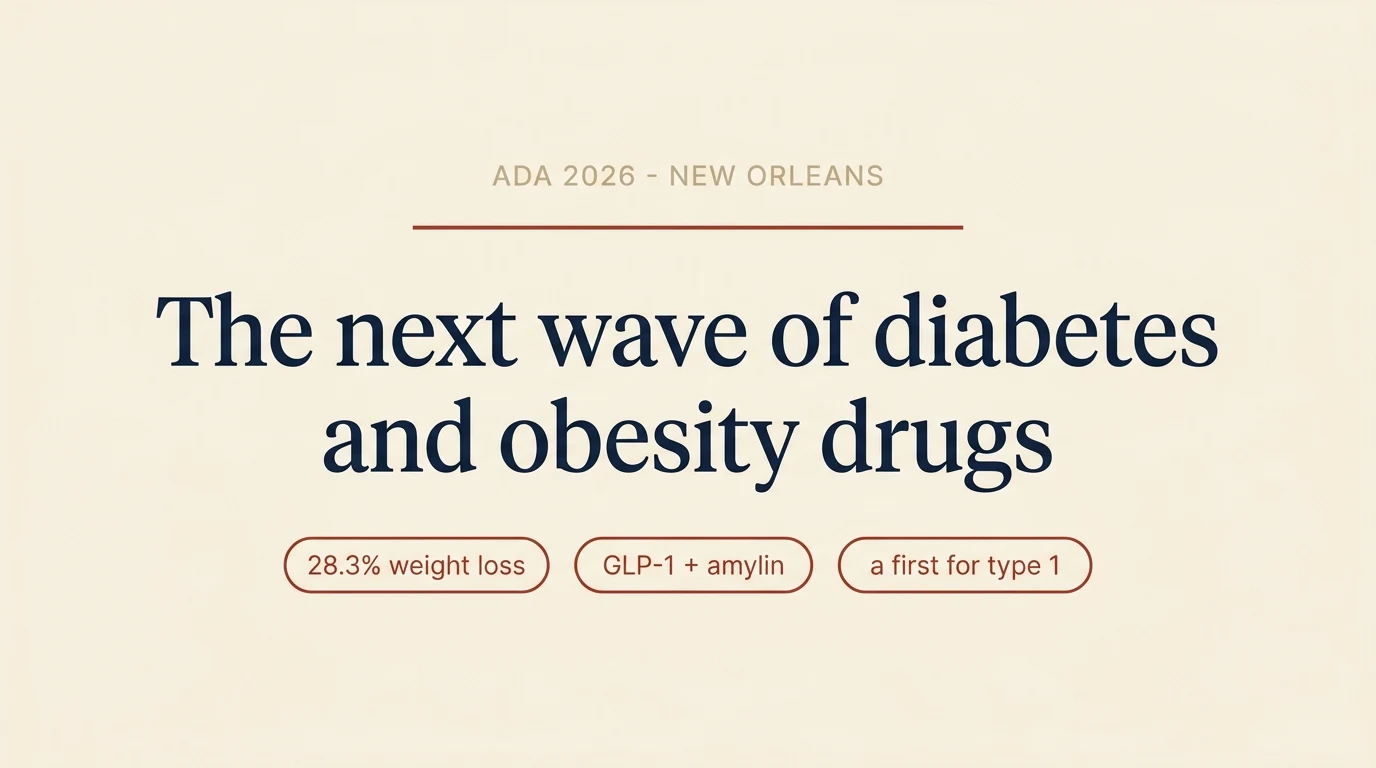
The obesity trial, TRIUMPH-1, was the eye-opener. Over 80 weeks, participants — who started with a body mass index above 35 — lost an average of 70.3 pounds, or 28.3% of their body weight, and nearly half lost more than 30%. In the interview, the ADA’s Dr. Rita Kalyani described that as on par with metabolic or bariatric surgery, and noted people kept losing weight out to 140 weeks in an extension. Retatrutide is still investigational — not approved — but these are among the largest weight-loss figures reported for a drug to date.
Adding amylin to the mix: CagriSema
A second approach combines two injectable hormones in one shot: semaglutide (a GLP-1 drug) and cagrilintide, an analogue of amylin. Amylin is a hormone released by the same pancreatic beta cells that make insulin, and it helps control blood sugar after meals — one amylin drug, pramlintide, is already approved for use alongside insulin. CagriSema pairs that mechanism with GLP-1.
The REIMAGINE trials tested it. REIMAGINE 1, a phase 3 study in 189 people with type 2 diabetes, gave CagriSema as a once-weekly injection followed by a period off treatment; it lowered blood sugar and, in some people, kept it within the range we’d call remission during that off-treatment window — a hint about how durable the benefit might be. REIMAGINE 3 looked at people already on basal insulin and found A1c fell on average from 8.8% to 6.5%, with weight reductions up to 12% and — notably for insulin users — no severe low-blood-sugar events. Like retatrutide, CagriSema is investigational.
A first for type 1 diabetes: acmopatide
Almost all incretin research has been in type 2 diabetes and obesity; there are no incretin-based drugs approved for type 1 diabetes. That’s what made acmopatide notable. It is a once-daily dual GLP-1/GIP agonist, and a phase 2 trial tested it in 111 adults with type 1 diabetes who also had overweight or obesity (mean age 41).
The drug improved blood glucose and produced dose-dependent weight loss of up to about 7% — a level the interview compared to the landmark Diabetes Prevention Program — and reduced participants’ insulin use by up to 15% versus placebo. Lower insulin needs can mean less glucose variability and a lower risk of hypoglycemia, which matters a great deal in type 1 diabetes. It was generally well tolerated. This is early, phase 2 work and still investigational, but it’s a real signal that incretin therapies could eventually reach type 1 diabetes.
Beyond drugs: CGM for type 2 not on insulin
Not everything at the meeting was a drug. The CONNECT trial asked whether continuous glucose monitors — devices most often prescribed for people on insulin — help people with type 2 diabetes who are not on insulin. It was a randomized controlled trial across 22 US primary care practices in 283 adults, with A1c ranging widely from 7.1% to 14.9%, over 26 weeks. Many were already on other treatments (37% on an SGLT2 inhibitor, 40% on an incretin drug), so the question was whether a CGM adds anything on top.
It did. Blood glucose improved in 82% of these non-insulin participants, with a substantial drop in time spent high, more time in the target range, and better quality of life and less diabetes-related distress. Because CGMs aren’t always covered for people who don’t use insulin, the trial carries real policy and coverage implications — and unlike the drugs above, this is a tool many people could use today.
Where mazdutide and orforglipron fit
Two other agents discussed at the meeting are ones we’ve covered in depth. Mazdutide, a GLP-1/glucagon dual agonist approved in China, posted a placebo-subtracted weight loss of about 15% in the 60-week GLORY-2 trial — see our full breakdown of GLORY-2. And orforglipron, a small-molecule GLP-1 taken as a daily pill (with no food or water restrictions), was FDA-approved for weight management this spring and lowered A1c by up to about 1.8 points when added to insulin in type 2 diabetes — see what the orforglipron trial showed. For how those two fit together, we pulled them into a separate roundup.
| Agent | Mechanism | Route | Studied in | Headline result | Status |
|---|---|---|---|---|---|
| Retatrutide | GLP-1 + GIP + glucagon (triple) | Weekly injection | T2D; obesity | ~28% weight loss in obesity (80 wks) | Investigational |
| CagriSema | GLP-1 + amylin | Weekly injection | T2D (± insulin) | A1c 8.8→6.5% on insulin; up to 12% weight | Investigational |
| Acmopatide | GLP-1 + GIP (dual) | Once-daily | Type 1 diabetes | ~7% weight; up to −15% insulin use | Investigational (phase 2) |
| Mazdutide | GLP-1 + glucagon | Weekly injection | Obesity (China) | ~15% placebo-subtracted weight | Approved in China; not US |
| Orforglipron | GLP-1 (oral) | Daily pill | Obesity; T2D add-on | up to ~1.8-point A1c drop added to insulin | FDA-approved for weight only |
What this study can't tell us
- Conference data, much not yet published — most of these results were presented at ADA 2026 and have not all completed full peer review; final figures may shift.
- A secondary source — this summary is based on a JAMA Medical News interview, not the original trial reports; we cite the interview, and the published trials where we’ve covered them separately.
- Mostly investigational — except orforglipron (FDA-approved for weight) and mazdutide (approved in China), these agents are not approved or available.
- No head-to-head comparisons — the agents were tested in different trials and populations and can’t be ranked against each other.
- Short and early — several were phase 2 or under about 80 weeks; long-term safety, durability, and cardiovascular outcomes remain open.
Step back from any single number and the pattern is clear: diabetes and obesity medicine is moving from one-hormone drugs to two- and three-hormone combinations, from injections toward pills, from type 2 toward type 1, and from drugs alone toward tools like CGMs. Retatrutide’s weight-loss figures approaching surgical territory are the headline, but the broader story is breadth — more mechanisms aimed at more people.
The cautions are the familiar ones. Almost everything here is investigational, conference data tends to look its best before full publication, and the questions that decide real-world value — long-term safety, durability after stopping, cardiovascular benefit, and above all cost and access — are exactly the ones a single meeting can’t answer. For people on the obesity–diabetes continuum, ADA 2026 is a reason for grounded optimism about the pipeline, not a prompt to act today.
Frequently asked questions
1.What is retatrutide, and when will it be available?
Retatrutide is an investigational once-weekly injection that targets three hormones at once — GLP-1, GIP, and glucagon. In trials presented at ADA 2026 it produced very large weight loss, but it is not FDA-approved and has no confirmed availability date.
2.What is CagriSema?
CagriSema is an investigational once-weekly injection that combines semaglutide (a GLP-1 drug) with cagrilintide, an analogue of the hormone amylin. It is not approved.
3.Is there a GLP-1 drug for type 1 diabetes?
Not yet — no incretin-based drug is approved for type 1 diabetes. Acmopatide, presented at ADA 2026, is an early (phase 2) investigational drug studied in people with type 1 diabetes. It's a signal that this could change, but it is not available.
4.Are these drugs FDA-approved?
Most are not. Of the agents here, only orforglipron is FDA-approved (for weight management), and mazdutide is approved in China but not the US. Retatrutide, CagriSema, and acmopatide are all investigational.
5.Should I get a CGM if I have type 2 diabetes and don't use insulin?
A 2026 trial (CONNECT) found continuous glucose monitors helped people with type 2 diabetes who aren't on insulin. Coverage varies, so it's worth asking your doctor whether a CGM makes sense for you — a conversation to have, not a step to take alone.
Sources
- A New GLP-1 Pill for Diabetes, Semaglutide With Amylin, Data From China, and More From ADA 2026 — JAMA (2026) · doi:10.1001/jama.2026.7591
- Treatment With 9-mg Mazdutide for Weight Reduction in Chinese Adults With Obesity (GLORY-2) — JAMA (2026) · doi:10.1001/jama.2026.8142
- Orforglipron Added to Titrated Insulin Glargine in Type 2 Diabetes (ACHIEVE-5) — JAMA (2026) · doi:10.1001/jama.2026.9512
Not medical advice. Educational summary of published research. Last reviewed Jun 20, 2026.